SitePermit by CivicLabs · Built for Victorian planning
Get it right before you lodge. Assess it faster when it lands.
SitePermit turns your council's planning scheme into clause-cited answers for both sides of the counter. Applicants know exactly what applies to their site and what to submit. Councils receive complete, evidence-backed applications — and spend their time on the judgement calls that matter.
- Grounded in the Victoria Planning Provisions
- Every answer cites its clause
- Guidance, never a determination
- Hosted in Australia
Applicant view
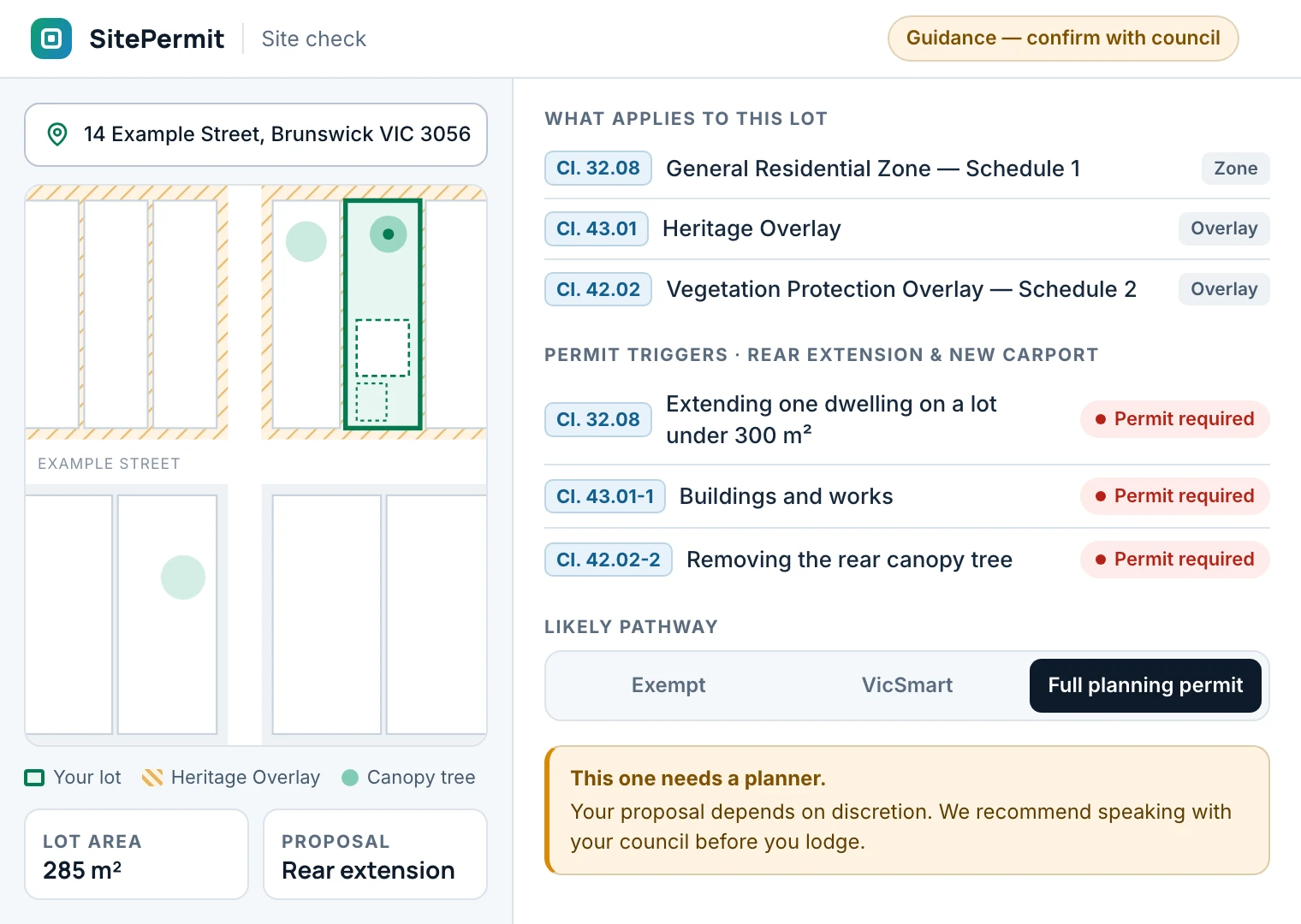
Proposal · Rear extension & new carport
A permit is triggered by the Heritage Overlay for buildings and works, and by the Vegetation Protection Overlay for removal of the rear canopy tree.
Council view
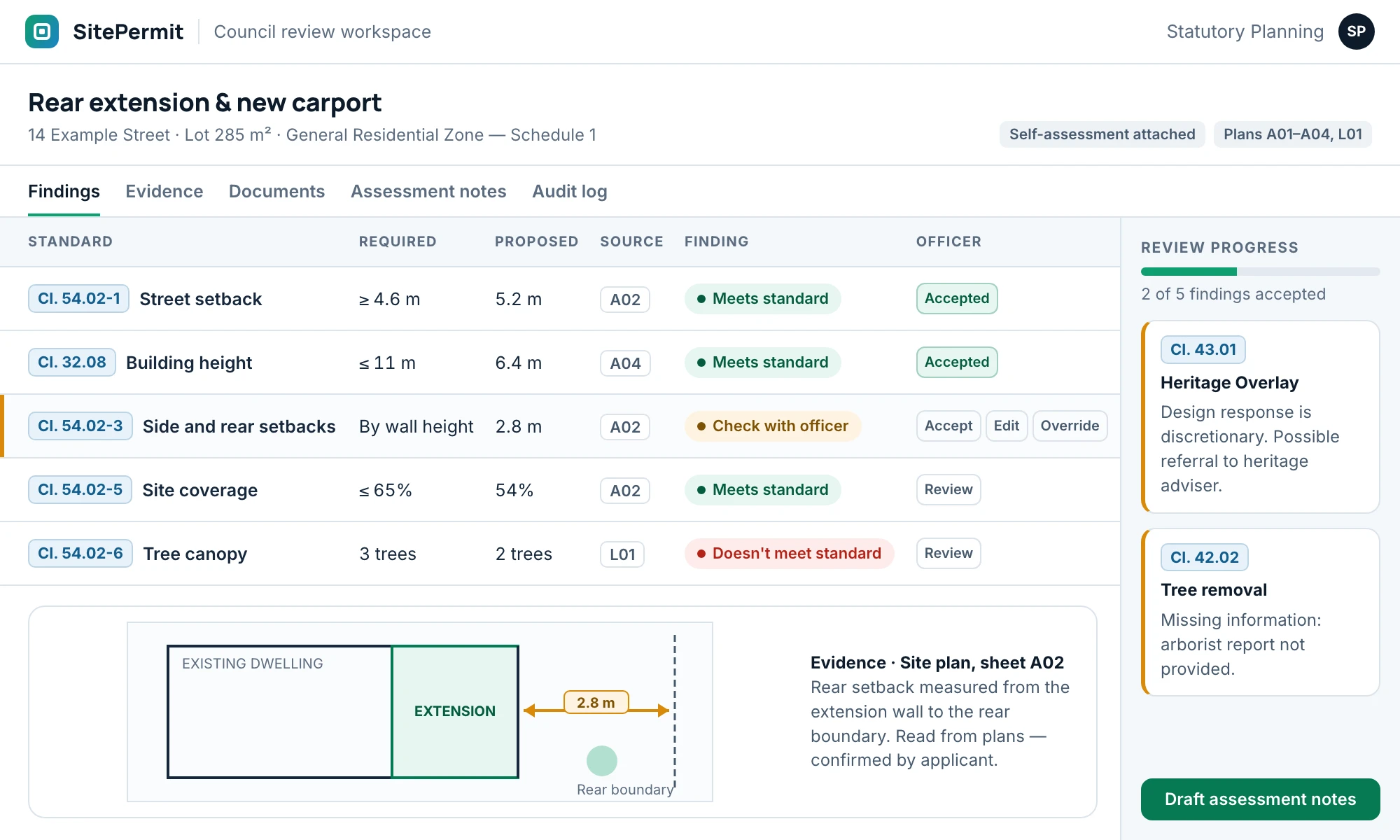
Officer review · Rear extension & new carport
Source: Site plan, sheet A02
The problem
Most planning delay is created before assessment even begins.
Applicants struggle to find out which rules apply to their site. Councils field the same questions again and again, then receive applications that are missing information. Both sides lose weeks.
For applicants
- The rules are hard to find and harder to read. Zones, overlays, schedules and local policies sit across different documents.
- You don't know what you've missed until council tells you. A Request for Further Information can pause the process and send you back to your designer.
- Advice is inconsistent. Forums, social media and "what my neighbour did" are not your planning scheme.
For councils
- Repeat enquiries consume officer hours. Counter, phone and email questions about zones, overlays and setbacks — over and over.
- Incomplete lodgements trigger RFIs. The statutory clock stops, rework begins and applicants get frustrated.
- Measurable checks are still done by hand. Setbacks, heights and site coverage are re-measured from plans for every file.
- Inconsistent advice erodes trust. Different officers, different days, different answers — and more disputes.
It's the same planning scheme on both sides of the counter. It should give the same answer.
SitePermit
One platform. Two sides. The same answer.
SitePermit is built around the full journey of a planning application — from the first "can I do this?" to the officer's review. Applicants and councils use different views of the same clause-cited rules model.
Prepare with confidence
- Check your address. See your zone, overlays and the provisions that apply to your parcel.
- Describe your proposal. Extension, new dwelling, townhouses, fence or tree removal.
- Find your pathway. Exempt, VicSmart or a full planning permit — before you spend money on plans.
- Check your design. Upload your plans and SitePermit reads the key measurements. Review them, then see a clause-by-clause check against ResCode standards.
- Get your checklist and draft statement. A document list specific to your proposal, and a draft written statement to refine with your designer or planner.
- Lodge complete. Submit knowing you've addressed what council needs.
Assess with evidence
- Publish on your site. An embedded site check in your branding, on your domain, powered by your planning scheme.
- Receive better applications. Lodgements arrive with the applicant's self-assessment, evidence and document checklist attached.
- Review, don't re-measure. Officers see each standard, the proposed value, the required value and the plan it came from — and can accept, edit or override.
- Spot what needs judgement. Discretionary matters, missing information and possible referrals are flagged for the officer, not decided for them.
- Draft faster. Clause-by-clause notes and assessment drafts that planners edit and sign off.
- See the patterns. Enquiry insight shows where your community is confused and which provisions cause the most friction.
What SitePermit does
Answers your planners can stand behind
Address-level site check
Enter an address and a proposal. SitePermit identifies the zone, overlays and provisions that actually apply to that parcel.
Every answer cites its clause
Results reference the exact provision, schedule and overlay relied on — so applicants and officers can verify the reasoning.
Pathway triage
Directs each enquiry to the right route — exempt, VicSmart or a full planning permit application — before anyone lodges.
Plan reading, human-checked
Upload drawings and SitePermit pre-fills key measurements such as setbacks, height and site coverage. Every value is editable and marked for review.
ResCode standards checks
Clause-by-clause checks of measurable residential standards, showing the proposed value, the required value and the result.
Application readiness
Generates the document checklist for that specific proposal, so what arrives at council is complete.
Draft written statements
A structured, clause-referenced draft statement — a starting point for the applicant and a head start for the officer.
Council review workspace
Officers review the applicant's assessment and evidence side by side, record findings and draft responses.
Rules, not guesswork
SitePermit evaluates the rules rather than predicting text. When a matter needs officer judgement, it says so and refers on.
Enquiry insight
See what your community is asking, where confusion clusters and which provisions cause the most friction.
What changes when both sides read the scheme the same way
For applicants — Clarity before cost.
Know what applies and what to submit before you commission detailed plans.
For councils — Fewer avoidable queries and RFIs.
Officer time moves from repetitive checks to genuine assessment.
For the community — Consistent, transparent advice.
The same question gets the same, traceable answer.
Built on the framework your officers already work in
SitePermit speaks the language of the Victoria Planning Provisions — not a generic approximation of "council rules". It models the instruments that determine an outcome at an address: zones, overlays, schedules, particular provisions and local policy.
We're structuring all 83 Victorian planning schemes into one rules model, covering every one of Victoria's 79 councils. It's designed for Victoria's residential standards, including Clause 54 and Clause 55, and the deemed-to-comply approach introduced through the Townhouse and Low-Rise Code (opens in a new tab).
83planning schemes
79councils
Onerules model
- Zones
- Overlays
- Local schedules
- Clause 54
- Clause 55
- VicSmart
- Local policy
Trust & governance
Built for the standards public sector work demands
Guidance, never a determination.
Council remains the responsible authority.
Abstains when unsure.
Discretion or missing information? It refers to a planner.
Fully auditable.
Every answer is logged with the provisions and inputs behind it.
Hosted in Australia.
Security, access control and privacy from the first line of code.
Who we are
Made in Melbourne by people who've delivered for local government
CivicLabs builds civic technology for Australian local government. We're a Melbourne team combining public-sector procurement and delivery experience with engineering from regulated, high-assurance environments. SitePermit is our first product, and we're building it alongside Victorian planners.
Early access
Help shape SitePermit — before it's built around someone else's council
We're working with a small number of Victorian councils and early applicant users to test SitePermit against real addresses and real applications.
Councils — become a foundation partner
- A walkthrough with real addresses from your municipality
- Input into which provisions and workflows we model first
- Foundation pricing and priority onboarding
- No obligation — a conversation, not a procurement process
Applicants and professionals — join early access
- Early access to the site check and design checks
- Help us test SitePermit on real projects
- For homeowners, builders, designers, architects and planners